Open RAN Series: Sowing the seeds of innovation (Part 2 of 3)
In Part 1 of our series “What is Open RAN?” we outlined how Open RAN is a disruptive technology/framework which is moving the telco infrastructure from a static, vertically integrated, propriety ecosystem to one that is dynamic and horizontally integrated which is removing vendor lock-in and broadening the supply chain. With this disruption come many opportunities but perhaps the key one is the opportunity for innovation. In this blog we focus on the innovative work currently being done across the myriad of Standards Developing Organisations (SDO) in the Eco system, and how this work is putting in place the ‘building blocks’ to ensure innovation is at the core of the Open RAN journey.
Unlike the Radio Access Technologies of GSM, UMTS, LTE and New Radio, where 3GPP is the principle standardization body, there are many SDO’s currently with Open RAN who are each driving the innovations we are seeing with the dis-aggregation of the RAN.
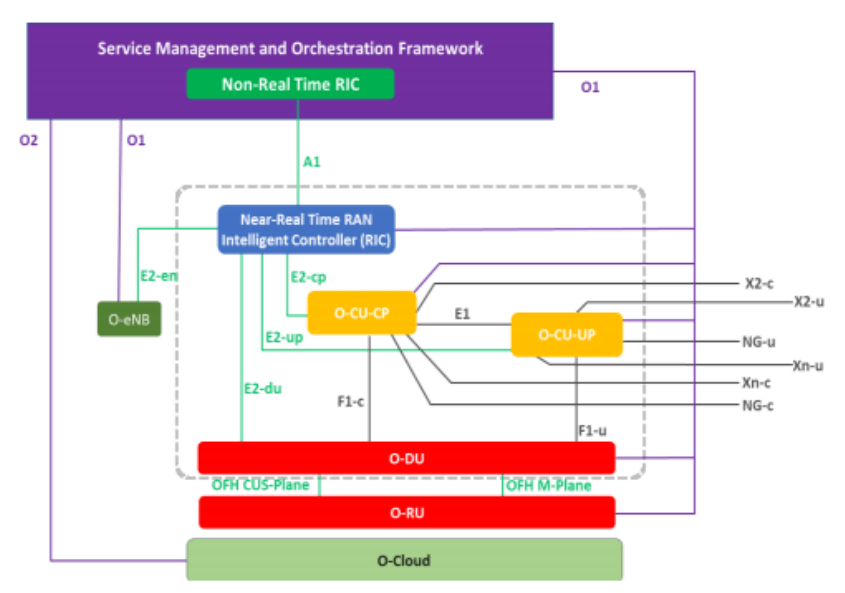
The Open RAN reference architecture described by the O-RAN Alliance clearly outlines the dis-aggregation of the RAN into distinct Network Elements (NE), and their associated interfaces, which is at the core of the work being done by the SDO’s.
Figure 1: O-RAN logical architecture
By dis-aggregating the functionality of the traditional RAN into smaller components spread across a number of NE’s, it drives diversification of the eco system as new and smaller vendors now have possibility to provide innovative solutions focused on a particular NE (e.g. O-CU layer 3 stack, near-RT RIC Radio Resource Management (RRM) applications). To this point the complexity and cost associated with developing a traditional RAN has acted as a barrier for these vendors, resulting in an ever-decreasing number of incumbents from whom MNOs can choose.
The decompensation of RAN described above in of itself will not be enough if the individual NE’s cannot be fully interoperable. To ensure this is possible, the Open RAN community is defining truly openinterfaces (i.e. open Fronthaul, F1/W1, E2, A1, O1, O2) which are key in avoiding the ‘closed’ propriety interfaces of today such as the CPRI fronthaul and X2 for inter eNB communication. Having these open interfaces are key to ensure that continued innovation is possible within an Open RAN deployment for (as yet unknown) Use Cases of the future.
An important innovation which is being brought to bear within the Open RAN architecture/framework is Network Function Virtualisation (NFV), which removes the need for proprietary hardware. Instead, the NE’s are packaged as Virtual Network Functions (VNF) or Cloud native Network Functions (CNF) on COTS commodity hardware, which allows MNO’s to run their network on standard servers with obvious CAPEX savings. NFV also improves scalability and agility by allowing MNOs to deliver new network services and applications on demand, without the need for deployment of additional hardware resources.
Given that an Open RAN deployment will most likely be a system composed of Network Elements and functionality from many different vendors, the complexity of a typical network will increase significantly. As a result, the main goal regarding Operation and Maintenance (O&M) for the next-generation mobile networks will be to hide this complexity from the operator. The key to this will be embedding intelligence within the NE’s such that the network will be Zero-Touch/Self- Healing. The work being done in O-RAN Alliance and ONF on the RAN Intelligent Controllers, and in Linux Foundation (for ONAP) and ETSI (for OSM) for Service and Management Orchestration (SMO) is driving the innovations around AI/ML within Open RAN.
While having a significant number of Open RAN SDO’s has the potential for some fragmentation, what we are seeing is that there is more and more collaboration and cooperation between them to promote Open RAN and drive innovation. The O-RAN Alliance is collaborating with the Linux Foundation, the Telecom Infra Project (TIP)and Open Networking Foundation (ONF) on development of the RAN Intelligent Controllers (RIC’s) platform. Another example is the recent joint Plugfests hosted by the O-RAN Alliance and the Telecom Infra Project (TIP) which focused on multi-vendor interoperability tests of 12 different O-RU/O-DU/O-CU combinations on behalf of the host operators Deutsche Telekom and Telecom Italia Mobile.
At the core of the Open RAN architecture are the principles of intelligence and openness, which is leading to the broadening of the vendor pool with new (often smaller) telco companies joining the large incumbents to drive innovative solutions to ensure the continued and accelerated momentum of Open RAN.
Exciting times ahead!
Don’t miss out on part three of our Open RAN blog series by subscribing.
Aspire was pleased to participate in Telekom Campus Fair 2026, held on June 24–25 in Bonn, where Deutsche Telekom, technology partners, and industry experts came together to discuss the technologies redefining network operations and digital infrastructure. Under this year’s theme, “Next Stop. Leading Edge.”, the event focused on the growing role of artificial intelligence, automation, […]
Aspire is proud to announce that we have officially joined the Red Hat Partner Program. This marks an important milestone in our journey to strengthen our cloud portfolio and deliver innovative solutions to telecom operators and enterprise customers worldwide. The telecom industry is undergoing rapid transformation, with cloud-native applications and automation driving modernization initiatives. Red […]
MWC Barcelona 2026 once again brought together the global telecom community to explore the technologies shaping the next decade of connectivity. This year’s event (2–5 March) placed a strong spotlight on AI-native networks, automation at scale, and the operational transformation required to support increasingly complex, multi-vendor, multi-cloud environments. NEC Aspire Technology returned to Barcelona with […]
In July 2025, Aspire was granted a US patent for its innovative method to accurately quantify sellable capacity in Fixed Wireless Access (FWA) networks. As operators accelerate 4G & 5G FWA rollouts, a key challenge is determining how many additional subscribers can be added per sector without degrading service performance. Aspire patented method addresses this […]
In a year defined by rapid advances in AI and automation, one thing remains constant: people are still at the heart of meaning, purpose, and success. At Aspire, that includes not only our teams, but also the clients and partners we work alongside every day. Because in our world, business isn’t just technical – it’s […]
We use cookies on our website to give you the most relevant experience by remembering your preferences and repeat visits. By clicking “Accept”, you consent to the use of ALL the cookies. However you may visit Cookie Settings to provide a controlled consent. Privacy Policy
This website uses cookies to improve your experience while you navigate through the website. Out of these cookies, the cookies that are categorized as necessary are stored on your browser as they are essential for the working of basic functionalities of the website. We also use third-party cookies that help us analyze and understand how you use this website. These cookies will be stored in your browser only with your consent. You also have the option to opt-out of these cookies. But opting out of some of these cookies may have an effect on your browsing experience.
Cookie
Type
Duration
Description
bcookie
0
2 years
This cookie is set by linkedIn. The purpose of the cookie is to enable LinkedIn functionalities on the page.
bscookie
1
2 years
cli_user_preference
session
1 hour
The cookie is used to store the yes/no selection the consent given for cookie usage. It does not store any personal data.
cookielawinfo-checkbox-advertisement
0
1 year
This cookie is set by GDPR Cookie Consent plugin. The purpose of this cookie is to check whether or not the user has given their consent to the usage of cookies under the category 'Advertisement'.
cookielawinfo-checkbox-analytics
0
1 year
This cookie is set by GDPR Cookie Consent plugin. The purpose of this cookie is to check whether or not the user has given the consent to the usage of cookies under the category 'Analytics'.
cookielawinfo-checkbox-functional
0
1 year
cookielawinfo-checkbox-necessary
0
11 months
This cookie is set by GDPR Cookie Consent plugin. The cookies is used to store the user consent for the cookies in the category "Necessary".
cookielawinfo-checkbox-non-necessary
0
11 months
This cookie is set by GDPR Cookie Consent plugin. The cookies is used to store the user consent for the cookies in the category "Non Necessary".
cookielawinfo-checkbox-performance
0
1 year
This cookie is set by GDPR Cookie Consent plugin. The purpose of this cookie is to check whether or not the user has given the consent to the usage of cookies under the category 'Performance'.
cookielawinfo-checkbox-preferences
0
1 year
This cookie is set by GDPR Cookie Consent plugin. The purpose of this cookie is to check whether or not the user has given the consent to the usage of cookies under the category 'Preferences'.
fpestid
0
1 year
Fpestid is a ShareThis cookie ID set in the domain of the website operator.
GPS
0
30 minutes
This cookie is set by Youtube and registers a unique ID for tracking users based on their geographical location
hubspotutk
0
1 year
This cookie is used by hubspot to keep track of the visitors to the website. This cookie is passed to Hubspot on form submission and used when deduplicating contacts.
IDE
1
2 years
Used by Google DoubleClick and stores information about how the user uses the website and any other advertisement before visiting the website. This is used to present users with ads that are relevant to them according to the user profile.
lang
0
This cookie is used to store the language preferences of a user to serve up content in that stored language the next time user visit the website.
lidc
0
1 day
This cookie is set by LinkedIn and used for routing.
lissc
0
1 year
Used to ensure there is correct SameSite attribute for all cookies in that browser.
li_gc
0
30 minutes
Used to store consent of guests regarding the use of cookies for non-essential purposes
li_sugr
0
2 months
rtc
0
1 month
Used as part of anti-abuse processes on LinkedIn
test_cookie
0
11 months
u
0
2 months
UserMatchHistory
0
4 weeks
viewed_cookie_policy
0
11 months
The cookie is set by the GDPR Cookie Consent plugin and is used to store whether or not user has consented to the use of cookies. It does not store any personal data.
VISITOR_INFO1_LIVE
1
5 months
This cookie is set by Youtube. Used to track the information of the embedded YouTube videos on a website.
YSC
1
This cookies is set by Youtube and is used to track the views of embedded videos.
_ga
0
2 years
This cookie is installed by Google Analytics. The cookie is used to calculate visitor, session, camapign data and keep track of site usage for the site's analytics report. The cookies store information anonymously and assigns a randoly generated number to identify unique visitors.
_gat_gtag_UA_131216975_1
0
1 minute
Google uses this cookie to distinguish users.
_gid
0
1 day
This cookie is installed by Google Analytics. The cookie is used to store information of how visitors use a website and helps in creating an analytics report of how the wbsite is doing. The data collected including the number visitors, the source where they have come from, and the pages viisted in an anonymous form.
__cfduid
0
3 months
Cookie associated with sites using CloudFlare, used to speed up page load times. According to CloudFlare it is used to override any security restrictions based on the IP address the visitor is coming from. It does not contain any user identification information.
__hssc
0
30 minutes
__hssrc
0
__hstc
0
1 year
__stid
0
1 year
The cookie is set by ShareThis. The cookie is used for site analytics to determine the pages visited, the amount of time spent, etc.
__stidv
0
1 year
The cookie is set by ShareThis. The cookie is used for site analytics to determine the pages visited, the amount of time spent, etc.
Necessary cookies are absolutely essential for the website to function properly. This category only includes cookies that ensures basic functionalities and security features of the website. These cookies do not store any personal information.
Any cookies that may not be particularly necessary for the website to function and is used specifically to collect user personal data via analytics, ads, other embedded contents are termed as non-necessary cookies. It is mandatory to procure user consent prior to running these cookies on your website.
Analytical cookies are used to understand how visitors interact with the website. These cookies help provide information on metrics the number of visitors, bounce rate, traffic source, etc.
Advertisement cookies are used to provide visitors with relevant ads and marketing campaigns. These cookies track visitors across websites and collect information to provide customized ads.
Performance cookies are used to understand and analyze the key performance indexes of the website which helps in delivering a better user experience for the visitors.
Functional cookies help to perform certain functionalities like sharing the content of the website on social media platforms, collect feedbacks, and other third-party features.