








Aspire is part of NEC!


Telecom networks are becoming increasingly complex, with rising service demands and alarm volumes. Over 50 employees depend on each operator footprint to maintain performance and reliability, making operational efficiency critical.

Based on industry figures, operators face over 1,000,000 alarms per week, with 100,000 classified as critical. Manual handling of these alerts leads to inefficiencies, elevated operational costs, and risks of service disruption.

Traditional processes are slow, error-prone, and resource-intensive. To maintain service quality and meet performance targets, operators must adopt AI-driven automation to accelerate resolution times, anticipate issues, and reduce overall OPEX.
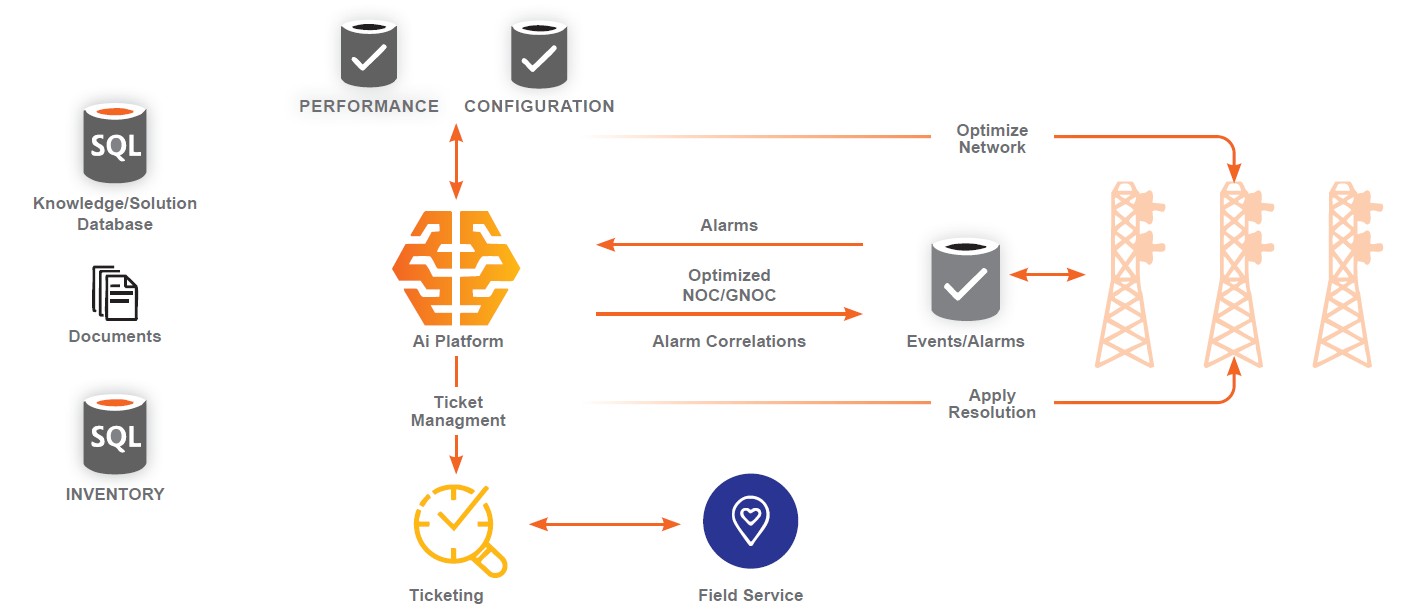
The Aspire autonomous, zero-touch network operations solution is an AI Agent that removes the challenges faced by traditional Network Operation Centres (NOCs) through:

Aspire Network Operations AI Agent leverages GenAI for autonomous alarm & KPI analysis, decision, and action with continuous feedback and learning.
Generative AI (GenAI) and Large Language Models (LLMs) enhance zero-touch operations by enabling intelligent, real-time decision-making. These AI models analyse vast amounts of network data, predict potential failures, and automate troubleshooting. LLMs process unstructured logs, alarms, and documentation to derive actionable insights, improving accuracy and efficiency while reducing human intervention.

Reduced Operational Costs: Lower resource dependency and overheads
Improved Efficiency: Faster resolution times and reduced service disruptions
Enhanced Customer Experience: Higher network stability and quality of service
Scalable & Future-Proof: AI-driven adaptability for evolving telecom needs
Aspire Network Operations AI Agent is part of the Aspire Telecoms Automation Platform (ATAP), an AI and GenAI-powered platform, which enhances network efficiency, reduces OPEX, and enables zero-touch operations through automated data migration and closed-loop operations. It is structured into five categories for different use cases: